.svg)


We're working on this quiz!
Come back soon to test your knowledge about the
Come back soon to test your knowledge about the
Tasmanian Tiger
.webp)

.webp)
.webp)
Tasmanian tigers were carnivores that hunted a variety of prey. Their diet included kangaroos, wallabies, wombats, possums, bandicoots, birds, and small mammals like rodents. After European settlers arrived, they were also blamed for killing sheep and chickens, though this was likely exaggerated. Tasmanian tigers were pursuit predators that would chase prey until it was exhausted rather than ambushing like cats. They had a stiff, awkward running style but could maintain a steady pace over long distances. Their powerful jaws and sharp teeth allowed them to crush bone and consume nearly all of their prey. They typically hunted alone or in pairs, often at night or during dawn and dusk. Some reports suggest they would sometimes hunt cooperatively in small family groups.
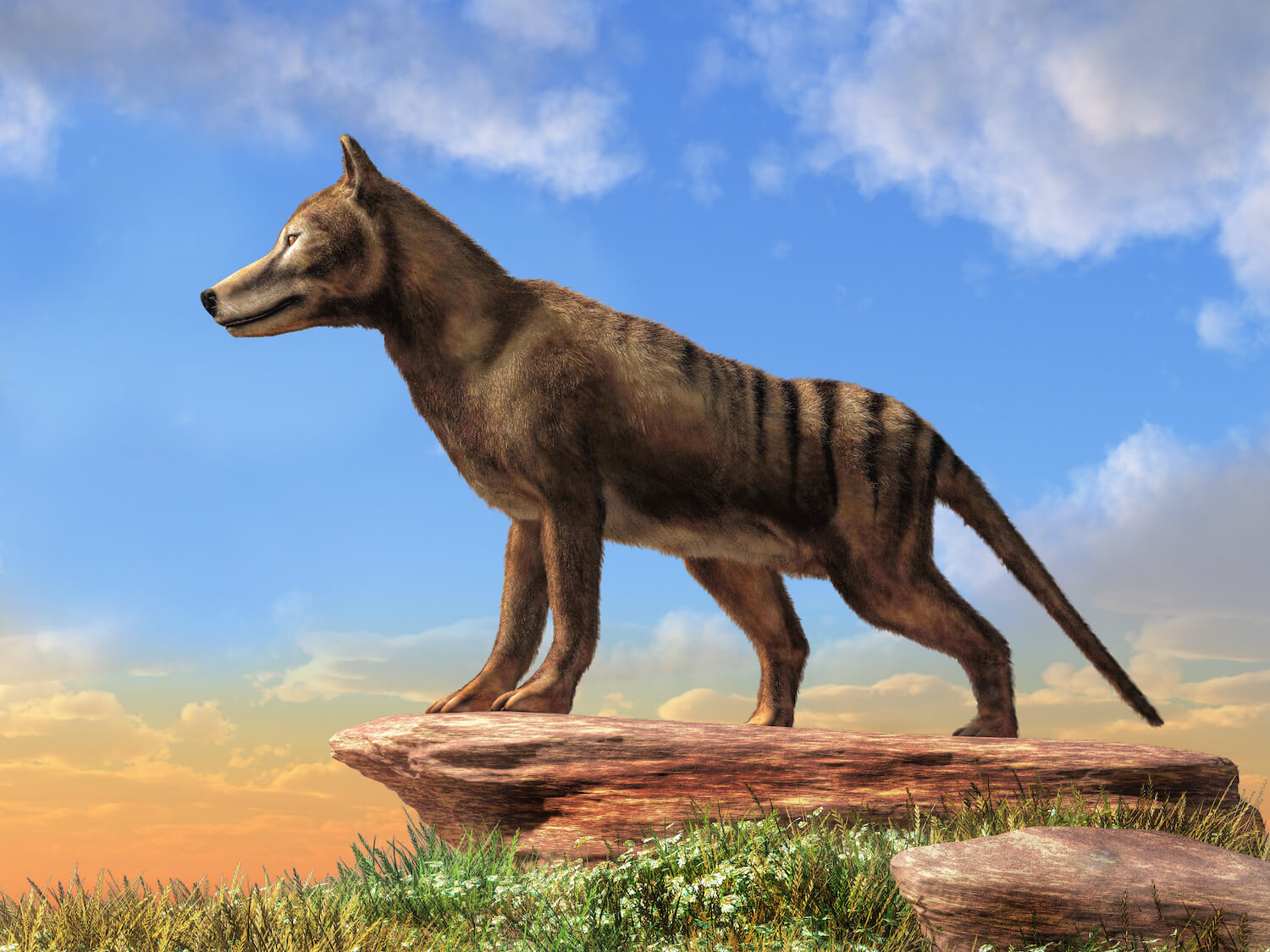
The Tasmanian tiger, scientifically known as the thylacine, is one of the most extraordinary and mysterious animals in recent history. Despite its dog-like appearance, it was actually a marsupial - meaning females carried their young in a pouch just like kangaroos. Adults measured about 3-4 feet long (not including their 20-inch stiff tail) and stood about 2 feet tall at the shoulder, weighing 40-70 pounds. They had short, sandy-brown or yellowish-brown fur with 15-20 distinctive dark brown or black stripes running across their back from shoulders to tail - earning them the "tiger" nickname. Their head was dog-like with a long snout, but their body had a unique blend of features: the stiff tail of a kangaroo, the pouch of a marsupial, and the overall shape of a wolf.
The Tasmanian tiger is a remarkable example of convergent evolution - when unrelated animals develop similar features because they live similar lifestyles. Though thylacines were marsupials, they evolved to look and hunt like wolves and dogs (which are placental mammals) because they filled the same ecological role as a top predator. Their jaws could open extraordinarily wide - up to 80 degrees - giving them a gaping, almost reptilian appearance when threatened. They had a unique hopping gait when moving slowly but could run more smoothly when chasing prey. Thylacines were generally shy, nocturnal animals that avoided humans when possible. Females gave birth to tiny, underdeveloped young (like all marsupials) that would crawl into the backward-facing pouch and continue developing while attached to a nipple for about three months.
The story of the Tasmanian tiger is one of tragedy and mystery. When European settlers established sheep farms in Tasmania in the 1800s, they blamed thylacines for livestock deaths (though feral dogs and poor farming practices were often the real culprits). The Tasmanian government placed bounties on thylacines, paying hunters for each animal killed. Between 1888 and 1909, over 2,000 bounties were paid. Combined with habitat destruction, disease, and competition with introduced dogs, the thylacine population collapsed. The last confirmed individual died at Hobart Zoo on September 7, 1936. However, the story doesn't end there - since 1936, over 1,000 sightings have been reported across Tasmania and even mainland Australia. Some of these sightings come from highly credible witnesses, including a 1982 report from a parks ranger that was described as "irrefutable and conclusive" by wildlife officials. While scientists estimate there's only a small chance thylacines still exist, the continued sightings keep hope alive.
.jpeg)
.jpeg)
.jpeg)



.jpeg)


.jpeg)
.jpg)
.jpeg)
.jpg)
.jpeg)


.jpg)
.jpg)


.jpg)
.jpg)
.jpg)

.jpeg)
.jpg)
.jpg)
.jpg)
.jpg)

